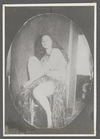
The James Reese Europe Photograph Collection mainly depicts some aspects of his career as a musician and conductor from the early 1900s to the 1950s.The collection consists of individual and group portraits and candid shots of Europe; portraits of his wife, Bessie; some candid shots of family members and friends; group portraits and views of the 369th Infantry Band; group portraits of musicians, musical groups and a theatrical organization; a reproduction of the cover to some sheet music; and some architectural views. The collection lacks views of his early life and is limited in depicting his personal life.The collection includes a candid shot of Europe, with Bessie, driving through New York City (1915); a portrait of a young Bessie Simms Europe as an entertainer (n.d.); an unidentified candid shot of friends and family members; a group portrait of The Frogs, an all-male African-American theatrical organization, that includes Europe, J. Rosamond Johnson, George W. Walker, Lester Walton and Bert Williams, among others (ca. 1908); a group portrait of the Clef Club's concert orchestra, which was conducted by Europe (ca. 1910); a group portrait of Europe's Society Orchestra, which includes Noble Sissle (ca. 1913); studio and candid portraits of Europe as a lieutenant and the conductor of the 369th Infantry Band during and immediately following World War I (1917-1919); views of Europe and the 369th Infantry Band in France (1917) and upon returning to the United States (1919); and a view of Europe's funeral procession in New York City (1919).Also included are group portraits of Europe's String Octett, managed by Noble Sissle and featuring Opal Cooper and Harry Williams (ca. 1916), and Will Marion Cook's Southern Syncopated Orchestra (ca. 1921); a photographic reproduction of the cover for the sheet music to "Castle House Rag," composed by Europe, which depicts the dance team of Vernon and Irene Castle (1913); a 1950s exterior view of the Mechanics Hall, Boston, Massachusetts, where Europe was fatally stabbed in 1919; and a snapshot of Noble Sissle and Patricia Europe visiting a memorial site to James Reese Europe at Lucky Lakes, New York (1956).
Content: Some photographs bear news agency handstamps on verso; some images have photography studio name printed on recto. Some images have handwritten notations on verso and/or recto; some photographs have printed captions on recto. Some items are duplicates.
Content: Collection contains work by R.E. Mercer, White Studios, International News Photo, and United Press International, among others.
Biographical/historical: James Reese Europe, composer and conductor, was born in Mobile, Alabama, in 1881. Raised in Washington, D.C., he moved to New York City, in 1903, where he established himself as a leading composer and director in black musical theater. In 1910, Europe helped to organize the Clef Club, a union and booking agency that helped to improve conditions for black musicians in New York. He also conducted the Clef Club, later the Tempo Club, orchestra which earned the reputation as a prestigious black symphonic orchestra. Overseas during World War I, Europe formed and conducted the acclaimed 369th Regiment Band which was lauded for its mix of blues, ragtime and jazz in its arrangements. In 1919, after returning to the United States hailed as America's "jazz king," Europe died from a stab wound in Boston after a backstage altercation with a deranged band member.
Content: Forms part of: James Reese Europe Collection.