Adolph S. Tomars Oscar Hammerstein I research papers

This collection is also available in Archives & Manuscripts
View In Archives »

Collection Data

Description
The papers consist mostly of clippings and notes on the career of Oscar Hammerstein I, compiled by Adolph S. Tomars.
Names
Tomars, Adolph S., 1908-1985 (Creator)
Hammerstein, Oscar, 1846-1919 (Contributor)
Tomars, Semion (Contributor)
American Music Collection (Associated name)
London Opera House (London, England) (Associated name)
Manhattan Opera Company (Associated name)
Manhattan Opera House (New York, N.Y.) (Associated name)
Dates / Origin
Date Created: 1878 - 1980
Library locations
Music Division
Shelf locator: JPB 03-8
Topics
Cigar industry -- Patents
impresarios -- United States
Opera -- Production and direction -- England -- London
Opera -- Production and direction -- New York (State) -- New York
Opera producers and directors -- Great Britain
Opera producers and directors -- United States
Theaters -- England -- London
Theaters -- New York (State) -- New York
Theatre management
impresarios
Inventors
Opera producers and directors
Theatrical managers
Genres
Clippings
correspondence
Photographs
Programs
Notes
Biographical/historical: Adolph S. Tomars, a sociologist and educator, was born on Feb. 2, 1908 in New York City to Semion and Rose Tomars. He received his B.A., M.A., and Ph.D. from Columbia University. Tomars married the former Regina Rubinoff in 1932; they had one daughter, Adrea Ruth. He was a member of the City College of New York faculty and later became chairman of the Sociology Department there. Tomars also taught at New York University and Hofstra University. In 1959, he received a Guggenheim fellowship. He was the author of the book, Introduction to the Sociology of Art, published in 1940. He died in New York City in March 1985. Opera stage director, impresario, and onetime concert singer, Semion Tomars, was born in Bobruisk, Russia around 1876. He sang in Russia, Vienna, and London before coming to the Metropolitan Opera Company at the turn of the century. After 1908, Semion Tomars was stage manager for the opera productions of Oscar Hammerstein I at the Manhattan Opera House and the London Opera House. He was associated with Hammerstein until the latter’s death. Semion Tomars also directed productions for the Chicago-Philadelphia Opera Company, the Century Opera Company, and the Society of American Singers. He directed his own companies in London and New York, including the National Opera Guild in 1927, whose mission was to produce opera in English. His wife, Rose, was a Polish born soprano who performed in Steinway Hall in 1934. Semion Tomars died of a heart attack in 1943. Oscar Hammerstein I, theatrical manager and impresario, inventor, and composer, was born in Berlin on August 1, 1846. Running away to New York at the age of sixteen, he found work in the cigarmaking industry. Hammerstein began to invent devices related to cigarmaking and is said to have made over $1,000,000 from his inventions. He also edited (some sources say founded) the United States Tobacco Journal, which he successfully ran until 1885. His first theatrical venture was writing three one-act comedies in German; these were produced by a New York City local theater in 1868. In 1870, Hammerstein became lessee and manager of the Stadt Theatre (later the Windsor) in New York City. The Harlem Opera House was the first theater he built; it was completed in 1880. Here he produced operas in English, to artistic and financial failure. Among Hammerstein’s other theaters were the Columbus Theatre (1890?), Olympia Music Hall (1895), Victoria Music Hall (1899), and the Republic (1900). He was also part owner of Koster and Bial’s vaudeville house, as well as other theaters. To realize his ambition of presenting grand opera in English at popular prices, Hammerstein built the Manhattan Opera House on Thirty-fourth Street in 1906, competing with the Metropolitan Opera House. Hammerstein also built the Philadelphia Opera House in 1908. In 1910, he was paid a large sum (reports vary between $1,000,000 and $2,000,000) by the Metropolitan Opera to cease producing opera in New York and Philadelphia for ten years. Hammerstein then went to England, where he opened the London Opera House in 1911. It failed after its first and only season. He returned to New York and built the American Opera House in 1912, but was legally prevented from producing opera there. Hammerstein renamed the theater the Lexington Theatre and presented popular entertainments in it. Hammerstein was married three times and had four sons and two daughters. He died August 1, 1919 in Lenox Hill Hospital due to complications from diabetes.
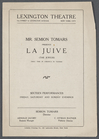
Content: These research materials consist primarily of clippings and notes compiled by Adolph S. Tomars, son of Semion Tomars, who was an associate of Oscar Hammerstein I. The purpose of the research is unclear. There are a small number of photographs, programs, and letters mostly relating to Hammerstein’s theaters. A large portion of the subject files cover subjects such as opera, music, and theater, and includes clippings on personalities from the era of Oscar Hammerstein I, or of those who performed in his theaters. There are also a few production materials relating to opera companies with which Semion Tomars was associated. Also included are materials relating to Oscar Hammerstein I’s career, such as descriptions published by the U. S. Patent Office of his numerous inventions. There are also handwritten notes, probably by Semion Tomars, giving his impressions and recollections of Hammerstein.
Physical Description
Extent: 3 linear feet (6 boxes)
Type of Resource
Text
Identifiers
Other local Identifier: JPB 03-8
NYPL catalog ID (B-number): b16098346
MSS Unit ID: 20318
Universal Unique Identifier (UUID): 3049e3a0-850e-013e-8c7d-0242ac110002
Show filters Hide filters
collection
x Adolph S. Tomars Oscar Hammerstein I research papers
division
type
Date Range
to
1 result found