This collection is also available in Archives & Manuscripts
View In Archives »
Collection Data
- Description
- The Equity Library Theatre (ELT) was a theatre company in New York City from 1943 to 1989, founded by actor Sam Jaffe, a representative of the Actor's Equity Association, and George Freedley, curator of the Theatre Collection of the New York Public Library. ELT was dedicated to showcasing unemployed Equity actors in classic and modern plays and musicals and to provide free theatre to New Yorkers. The Equity Library Theatre records (1944-1990) document the entire artistic and business history of the organization through administrative files and production files.
- Names
- Equity Library Theatre (New York, N.Y.) (Creator)
- Dates / Origin
- Date Created: 1944 - 1990
- Library locations
- Billy Rose Theatre Division
- Shelf locator: *T-Mss 1995-008
- Notes
- Biographical/historical: Equity Library Theatre (ELT) was started in 1943 by actor Sam Jaffe, a representative of the Actor's Equity Association, and George Freedley, the curator of the Theatre Collection of the New York Public Library. During the 1940s, ELT productions were staged in small performance spaces in the city's public libraries, which inspired the company's name. In the fall of 1949, a temporary home for ELT was established at the Lenox Hill Playhouse, in the Lenox Hill Neighborhood House, at 331 East 70th Street. In 1950, ELT was incorporated as a nonprofit organization and as a tax-exempt corporation. It was controlled jointly by a Board of Directors and by Actor's Equity Association.
Equity Library Theatre was founded as a showcase theatre which would give actors an opportunity to play, develop and grow in their craft. By producing only revivals, ELT was purely an actor's theatre, rather than a producer's tryout, a director's experiment, or a playwright's developmental project. ELT was conceived as an outgrowth of Actors' Equity Association, and its productions only featured Equity actors. Equity was also a major financier for ELT in its early years. The producer John Golden was also a significant financial supporter of ELT, as were other wealthy patrons of the arts.
ELT not only provided an important service to actors, it also provided free theatre to audiences. In addition to modern drama and classics, ELT built a solid reputation for excellence in its presentation of full-scale musicals. One of its operating philosophies was to familiarize audiences with the broad spectrum of theatre over a few seasons. ELT also produced experimental productions, as part of the Informal Series. The Informals were original works and dramatizations of published materials.
ELT was influenced by the politics of its day. During the blacklist years, the company denounced Communism and only produced plays that could not have been interpreted as politically subversive. In the face of accusations of racial discrimination, ELT established a policy of interracial casting. In 1961, ELT moved from its home at the Lenox Hill Playhouse into the Master Theatre on Riverside Drive at 103rd St.
Community outreach and educational programs were an integral part of ELT. They distributed free passes to various senior citizen, school, neighborhood, and hospital organizations. Educational services included participation in the New York Board of Education's City-As-School program and college internship programs. In 1950, two subsets of ELT were born out of its commitment to serving the community. Equity Community Theatre (ECT) performed full plays at schools such as DeWitt Clinton High School and Bryant High School. Scrapbook Productions, which also performed in schools, produced shows usually comprised of three scenes from plays with historical subjects. ELT also had a job referral system to other theatres throughout the country, and offered loans of scenery, costumes, and props to area organizations.
George Wojtasik was Producing Director of ELT from 1966-1989. ELT won the Off-Broadway Theatre Tony Award twice, in 1953 and in 1977. Despite valiant fund-raising efforts, ELT was forced to close, due to financial concerns, in the 1989-1990 season.
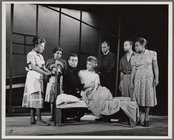
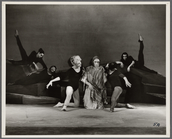
- Content: The Equity Library Theatre records (1944-1990) document the entire artistic and business history of the organization through production files and administrative files. The production files cover the productions of ELT and its associated companies, the Equity Community Theatre and Scrapbook Productions. Production Files consist of programs, fact sheets, production invitation information, correspondence, publicity materials, and, in some cases, photographs. The administrative files document the day to day running of a nonprofit theatre company. They contain such items as correspondence, publicity materials, committee meeting minutes and information on company elections, playwrights, schedules, community outreach, fund-raising, benefits, office procedures, membership, and clearance rights.
- Physical Description
- Extent: 33.77 linear feet (89 boxes)
- Type of Resource
- Text
- Identifiers
- Other local Identifier: *T-Mss 1995-008
- NYPL catalog ID (B-number): b19776616
- MSS Unit ID: 18863
- Universal Unique Identifier (UUID): e61494e0-989e-013d-06d3-0242ac110002