This collection is also available in Archives & Manuscripts
View In Archives »
Collection Data
- Description
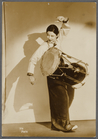
- Hadassah was a pioneer of Israeli and Indian (Hindu) dancing in America, and a choreographer of rare taste and artistic integrity. Hadassah was also a well-admired instructor, who taught Israeli and Indian dance workshops across the United States and abroad. She was a faculty member, board member and chairwoman of the ethnic division at the New Dance Group Studio in Manhattan.
- Names
- Hadassah, 1909?-1992 (Creator)
- Epstein, Milton
- Kodrat, R. M.
- La Meri, 1898-1988
- Shawn, Ted, 1891-1972
- Tagore, Rabindranath, 1861-1941
- Wiradat, R. M.
- New Dance Group (New York, N.Y.)
- Tagore Society of New York
- Dates / Origin
- Date Created: 1938 - 1988
- Library locations
- Jerome Robbins Dance Division
- Shelf locator: *MGZMD 135
- Topics
- Dance teachers
- dancers
- Indian dance
- Genres
- Clippings
- Correspondence
- Programs
- Notes
- Biographical/historical: Hadassah was an American, born in 1909 in Jerusalem. Her father was an American rabbi.
There are two versions of how she became interested in the dances of India. The first goes like this: When she was eleven years old, while Palestine was under the British Mandate, she witnessed the cremation of a Hindu soldier in Sarafend, Palestine. The music affected her to the point of fervor. The second version goes like this: As a young girl, riding in a horse-driven carriage from Jerusalem to Jaffa, her family heard chanting from off the road. Pulling over to investigate, her father discovered to his surprise that these men were not Hasidim reciting their cantorials, but Hindus in the service of the British Army. Her father's curiosity was aroused, and the family visited with the solders as they sang more. Being a cantor himself, her father chanted some of the liturgical melodies of Hebrew prayer and was amazed at their similarity to the Indians' hymns. Hadassah, too, was struck by these commonalities... "I came to the conclusion that if the chants of the Hindus and the Hasidic are similar, and if the music is the handmaiden of the dance, Indian dance must be similar to ancient Hebrew dance."
Hadassah made her professional debut in 1938, with Japanese dancer Kenji Hinoke. She made her solo debut on January 11, 1945 in a program shared with Josephine Premice, and Pearl Primus. Hadassah and Company debuted at the YM/YWHA on June 4, 1950. During the 1950s and 1960s she performed many times at Jacob's Pillow Dance Festival in Becket, Massachusetts. She toured India and Israel in 1959.
She was a faculty member, board member and chairwoman of the ethnic division at the New Dance Group Studio in Manhattan.
Her best-known work was Shuvi Hafshi (Return My Soul), based upon Psalm 116. "It is this dance that personifies Hadassah's ingrained spirituality, her respect for the incorporeal as well as substance, instilled for life in that ancient city of religion."
"Broadway Hindu, another popular dance, was a parody on the so-called Hindu dancing shown in American films, in costume, expression and choreography, it was deliciously realistic, in fact a chastened version." Her Tagore Suite, commissioned by the Tagore Centenary Committee, was performed for the first time in 1961.
Hadassah was married to Milton Epstein soon after coming to the United States. She died of cancer Nov. 18, 1992, in Manhattan at the age of 83.
Sources:
"Hadassah: A Career Kissed by the Gods", Arabesque, Sept/Oct. 1983, p. 6-8, 29. "Dance Recital by Hadassah", Times of India, March 15, 1959.
- Content: The Hadassah Papers consists of correspondence, newsletters, clippings from newspapers and dance-themed magazines, programs and playbills with Hadassah and other dancers and dance companies and photographs. The collection spans the years of 1937-1988, with a heavy concentration on the years 1947-1961. There is some personal correspondence although this is limited. The majority of the collection is comprised of newspaper clippings and copies of dance magazines in which Hadassah is highlighted.
- Physical Description
- Extent: 10.49 linear feet (11 boxes)
- Type of Resource
- Text
- Identifiers
- Other local Identifier: (S) *MGZMD 135
- NYPL catalog ID (B-number): b15958665
- MSS Unit ID: 19773
- Universal Unique Identifier (UUID): 0f52f0c0-5639-013c-0f3a-0242ac110003