This collection is also available in Archives & Manuscripts
View In Archives »
Collection Data
- Description
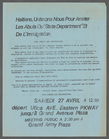
- Ira Gollobin, an immigration rights attorney and author, served as pro bono counselor to refugees from all over the world including Nazi Germany and Duvalierist Haiti. His work with Haitian refugees, the purview of this collection, began in 1974. In this capacity he served as lead counsel on several major cases that were pivotal to the rights of Haitian refugees, the so-called "boat people." Gollobin's critical role as lead counsel was as important as his active role in developing grassroots organizations that made the public aware and active in Haitian refugee legislation issues. Through his affiliation with major organizations such as Church World Service and the communist founded American Committee for the Protection of the Foreign Born, he created channels for Haitian-American led coalitions such as the National Coalition for Haitian Rights and Haitian Refugee Center, two prominent activist organizations, to form and help steer the campaign for the rights of Haitian refugees. He organized a broad-based strategy that combined legal advocacy to secure basic freedoms for Haitians with long-term policy arguments aimed at granting thousands of Haitian immigrants the right to due process in filing asylum claims. The Haitian Refugee Collection, 1972-2004, documents Ira Gollobin's involvement in multiple legal battles related to Haitian political asylum from the 1970s to the early 1990s. The collection highlights much of the legal and organizational features of the plight of Haitian refugees entering the United States in the late twentieth century. It represents one particular U.S. immigration discourse and the different treatment accorded to some refugees. The collection consists largely of drafts and copies of legal documents, meeting summaries, public outreach material that includes petitions, flyers, pamphlets, and other galvanizing materials; administrative papers from his various organizational affiliations; and research material for refugee asylum and cases. It covers the latter part of Gollobin's legal career beginning with his tenure as a legal consultant for the National Council of Churches in 1974, and continuing through his advocacy and consultant work until 2004 on behalf of Haitian organizations.
- Names
- Gollobin, Ira, 1911- (Creator)
- Dates / Origin
- Date Created: 1972 - 2004
- Library locations
- Schomburg Center for Research in Black Culture, Manuscripts, Archives and Rare Books Division
- Shelf locator: Sc MG 315
- Topics
- Chisholm, Shirley, 1924-2005
- Gollobin, Ira, 1911-
- Jean-Juste, Gérard, 1946-2009
- Joseph, Raymond
- Lemoine, P. (Patrick)
- McCalla, Johnny, 1955-
- Sansaricq, Guy, 1934-
- American Committee for Protection of Foreign Born
- Haitian Refugee Center (Miami, Fla.)
- Lawyers Committee for Human Rights (U.S.)
- National Coalition for Haitian Rights (United States)
- National Council of the Churches of Christ in the United States of America
- National Council of the Churches of Christ in the United States of America. Church World Service
- Rescue Committee for Haitian Refugees (U.S.)
- Asylum, Right of -- United States
- Politics and government -- Bahamas
- Black authors
- Emigration and immigration law
- Haiti -- Emigration and immigration
- Haiti -- Politics and government
- Haitian Americans -- Florida
- Illegal immigration
- Political refugees
- Refugees -- Government policy
- Refugees -- Haiti
- Refugees -- United States
- United States -- Emigration and immigration
- United States -- Politics and government
- Genres
- Documents
- Ephemera
- Correspondence
- Notes
- Biographical/historical: Ira Gollobin was an immigration attorney, who began his career in this field working with clients referred by the American Committee for Protection of the Foreign Born in the late 1930s. Between 1936 and 1942, many of Gollobin's clients were refugees from Nazi Germany and Franco-era Spain. Working closely with the League of American Writers, Gollobin helped secure asylum for a number of anti-Nazi German writers. In 1937, Gollobin co-founded the National Lawyers Guild, the first integrated bar association in the U. S. The Guild was a progressive organization that assisted the emergent labor movement while also denouncing the segregation policies of the American Bar Association and the United States more generally. (1: See Peter Erlinder, "National Lawyers Guild: History". National Lawyers Guild. For the Guild, Gollobin provided legal assistance to unions such as the Transit Workers Union and the Industrial Union Council while also maintaining an active pro bono caseload with the American Committee for Protection of the Foreign Born.
During the 1950s and 1960s, Gollobin's immigration practice expanded, as he frequently represented non-citizens who were the victims of anti-alien bills, as well as naturalized citizens and permanent residents who were persecuted on the basis of their membership or affiliation with organizations deemed suspicious and/or dangerous by the U. S. government. In 1967, Gollobin succeeded Blanch Freedman as general counsel to the American Committee for Protection of the Foreign Born, and served in that capacity until 1987.
Gollobin began working with Haitian refugees in 1974 during the presidency of Jean-Claude Duvalier. Between 1972 and 1977, an estimated 3,500 Haitians had arrived by boat on south Florida shores (2: Christopher Mitchell, Western Hemisphere Immigration (1992), page 133). In contrast with the professional and middle-class Haitians who had fled Haiti and immigrated to the U. S. and Canada in the 1950s and 1960s during the regime of François Duvalier, who had inaugurated the regime of terror and brutality that his son had continued, the majority of Haitians who arrived by boat in the 1970s were poor and had few American contacts, if any at all. When these immigrants were questioned by the Immigration and Naturalization Service, nearly all of them were denied the right to apply for political asylum on the grounds that they were economic refugees, and not political ones. Since U. S. refugee protocol requires all asylum applicants to demonstrate a "well-founded fear of being persecuted for reasons of race, religion, nationality, membership in a particular social group, or political opinion", (3: See 1951 Convention Related to the Status of Refugees.) and because the INS deemed these immigrants to be fleeing unemployment and poverty, not political persecution, the vast majority of Haitians were detained in holding centers and prisons while awaiting deportation hearings. The INS also denied work authorizations to most Haitians who were released on bond. In 1974, as a legal consultant to the Fact Finding Task Force of the National Council of Churches, Gollobin conferred with officials of the Immigration and Naturalization Service in Miami, Florida and in Washington, D. C. and interviewed over 30 Haitians in Miami who were seeking asylum. The Division of Churches and Society of the National Council of Churches then requested that Gollobin undertake, on a voluntary basis, formal representation of Haitians seeking political asylum. Gollobin accepted and, as a result, became one of the attorneys on record in a major habeas corpus action brought by Haitians seeking review of the denial of their applications for political asylum. The case, Marie Pierre v. U. S. A., went on to become the first of many Haitian cases that challenged U. S. foreign policy and refugee protocol on the grounds of unfair treatment, violation of due process, and racial bias. Gollobin served as the lead strategist for a number of these cases, organizing a defense team of attorneys and activists including Peter Schey, Rick Swartz, Ira Kurzban, Michael Hooper, Arthur Helton, and Rulx Jean Bart. Gollobin also worked with various civic, religious and labor groups to assist the Haitians by providing food, clothing, shelter and other charitable support pending the final determination of asylum claims.
When Gollobin agreed to undertake voluntary representation for the Haitians, he put together a broad-based strategy that combined local advocacy to secure basic freedoms for the Haitians with long-term policy arguments aimed to grant the thousands of Haitians in Florida the right to due process in filing asylum claims. The Haitian defense team sought to release detained Haitians and secure their right to employment in addition to challenging the distinction between economic and political refugees, a distinction the legal team deemed simplistic and even arbitrary.
Despite many successes won by Gollobin and the legal team, the Reagan administration instituted a two-part policy in the early '80s to guarantee that Haitians could not exercise their right to claim asylum: the detention of new arrivals and interdiction at sea. Beginning in May 1981, Haitian asylum seekers were detained at the Krome Avenue North Detention Center in Miami. Later, to avoid overcrowding and unrest, Haitians were sent to various federal penitentiaries throughout the United States. In addition to imprisonment, the Reagan administration authorized the interdiction by the U. S. Coast Guard of Haitian boats, granting the Coast Guard the authority to forcibly return Haitians to Haiti before they ever reached U. S. shores. Gollobin's legal team attacked the detention policy in Lucien Louis v. Alan C. Nelson, Commissioner of the Immigration and Naturalization Service, where they successfully challenged the imprisonment of over 1,850 Haitians in 14 facilities throughout the U. S. In the 1990 case Haitian Refugee Center v. James Carter, the lawyers challenged a government plan to forcibly relocate Haitians to a military facility in Puerto Rico, and in the 1991 case National Coalition for Haitian Refugees v. United States Coast Guard they petitioned against the interdiction program.
Ira Gollobin practiced law in New York City for over 70 years, and during this time he received numerous awards and honors from organizations including the American Committee for Protection of the Foreign Born, the National Council of Churches, and the Center for Immigration Rights, the American Immigration Lawyers Association, and several Haitian advocacy organizations. The work spearheaded under his leadership represents an important benchmark in the fight against anti-immigration legislation and policies over the past four decades.
- Content: The Ira Gollobin Papers, 1972-2004, document Gollobin's involvement in multiple legal battles related to Haitian political asylum from the 1970s to the early 1990s. The collection is divided into seven series: Cases, Affidavits, Organizations, Clippings, General Correspondence, Speeches and Writings, and Subject Files. The collection consists largely of drafts and copies of legal documents, meeting summaries, public outreach material, administrative papers, and research material for refugee asylum. It covers the latter part of Gollobin's legal career, beginning with his tenure as a legal consultant for the National Council of Churches in 1974, and continuing through his advocacy and consultant work until 2004 on behalf of Haitian organizations.
- Type of Resource
- Text
- Identifiers
- Other local Identifier: Sc MG 315
- NYPL catalog ID (B-number): b18889012
- MSS Unit ID: 20934
- Universal Unique Identifier (UUID): b82d0e60-d8d7-013c-b870-0242ac110002