TitleCostume for Les Sylphides
Additional title: Costume worn by Ruth Ann Koesun (1928-2018) in Mikhail Fokine’s Les Sylphides
NamesKoesun, Ruth Ann (Associated name)Ballard, Lucinda (Costume designer)Coghlan, Ellen (Donor)
CollectionRuth Ann Koesun collection
Costumes and Accessories
Dates / OriginDate Created: 1940 - 1969Place: New YorkPublisher: Lucinda Ballard?
Library locationsJerome Robbins Dance DivisionShelf locator: *MGZU 25-358
TopicsFokine, Michel, 1880-1942. SylphidesDance costume -- 20th centuryBallet -- Costume
GenresCostumestutus
NotesBiographical/historical: Ruth Ann Koesun was born in Chicago, Illinois in 1928. Her father, Paul Koesun was a well-known doctor in Chicago's Chinatown neighborhood. Koesun's mother, Mary Mondulick Koesun, was a nurse and later a housewife. Koesun's mixed background was often noted in the press, her father was Chinese-American, and her mother was of Russian descent. At six, Koesun began training with Edna Lucille Baum, who specialized in teaching young ballet dancers. Baum later encouraged Koesun to advance her technique at the Stone-Camryn School of Chicago, and to spend summers in New York City studying with ballet teachers Maria Swoboda and her husband, Vecheslav Swoboda.
In 1946, Koesun joined the Ballet Theatre (later known as American Ballet Theatre) and was paired with John Kriza, a fellow Stone-Camryn alumnus based in Illinois. When the couple wasn't touring with the Ballet Theatre, they often danced together in Chicago nightclubs and Summer Stock performances. Kriza and Koesun became the signature dancers in the Ballet Theatre's revival of Eugene Loring's Billy The Kid. The pair were closely identified with their Billy The Kid roles, and they performed the ballet with the rest of the company at the White House for President John F. Kennedy and First Lady Jacqueline Kennedy in 1962.
Koesun danced in other prominent roles including the Bluebird pas de deux from The Sleeping Beauty. She would partner with several notable ballet dancers, including Erik Bruhn, Nora Kaye, Maria Tallchief, and Violette Verdy. In the 1950s, Koesun often partnered with Eric Braun, another principal dancer with the Ballet Theatre. The two were married in 1947, but divorced after eight years.
Koesun and the Ballet Theatre toured worldwide. In the summer of 1946, they were the first American ballet company to perform in London after World War II. In September of 1955, the company was on a South American tour during the Revolución Libertadora (Liberating Revolution), the coup that ended the second term of Argentina's president, Juan Perón. After spending six days locked down in the Claridge Hotel in Buenos Aires, the company continued its production under the new administration.
After retiring from the American Ballet Theatre in 1969, Koesun returned to Chicago, where she served as the co-director of the dance department at the Hull House Association from 1969 until 1972. Koesun also worked in the archives of the Newberry Library starting in 1998, and began serving as the Assistant Director of the Chamber Opera of Chicago in 2005. Koesun remained involved in the dance world until she died in 2018.Statement of responsibility: Ballet TheatreBiographical/historical: Worn by Ruth Ann Koesun as a sylph in Les SylphidesAcquisition: Gift ; of Ellen Coghlan, 2021Exhibitions: The Polonsky Exhibition of The New York Public Library's Treasures, 2024-2025.
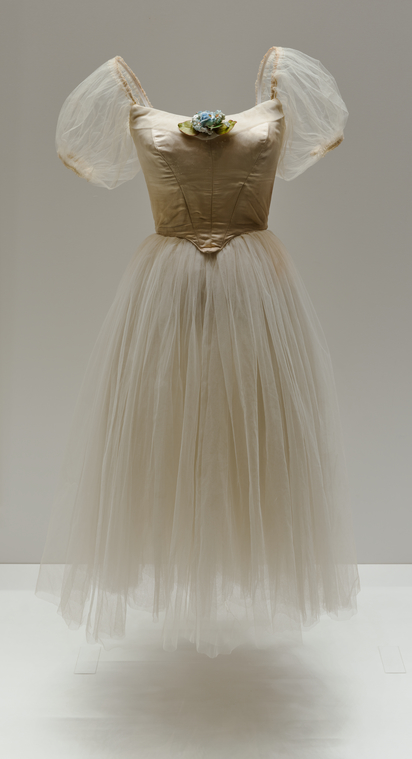
Physical DescriptionTulle (meshed textile)WireCottonExtent: 1 tutu : tulle, wire, cotton ; 102 x 52 cm
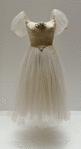
DescriptionThis Romantic-style ballet tutu features a soft, cream-colored fitted bodice with a modest neckline and short puffed sleeves, evoking the classical silhouette of 19th-century ballet costume. The calf-length skirt is composed of multiple layers of ethereal tulle, creating a light, floating effect characteristic of the "ballet blanc" tradition. Subtle gold embellishments enhance the garment's luminosity and dreamlike quality. A blue artificial floral corsage is affixed at the center front of the bodice, adding a delicate decorative accent. At the back closure, a pair of sylph wings constructed from tulle-covered wire is attached. These wings are detailed with silver sequins arranged to resemble delicate veins, reinforcing the costume's supernatural, airy aesthetic. The name 'Koesun' is inscribed in black marker on the interior of the front right section of the basque.
Type of ResourceThree dimensional object
IdentifiersMSS Unit ID: 186173Archives EAD ID: 3405649NYPL Exhibition ID: TL 20.01.PERF67RLIN/OCLC: 1523966887NYPL catalog ID (B-number): b23650983Universal Unique Identifier (UUID): d2336630-03d8-013d-847c-0242ac110002
Rights StatementThe New York Public Library holds or manages the copyright(s) in this item. If you need information about reusing this item, please go to: http://nypl.org/permissions
Item timeline of events
-
-
-
-